Problem
A lower-cost reorder policy can look better on forecast error and still create stockout risk. The gate tests whether the model policy stays above the service floor after lead time, cost weights, and SKU-level failures are applied
Built
- UCI Online Retail II transaction pipeline
- SKU daily demand aggregation
- seasonal baseline and model forecast
- base-stock reorder policy under lead time
- inventory simulation with cost, stockout, and service metrics
- cost-service frontier gate under a service floor
- lead-time uncertainty grid
- named failure-mode report
- SKU-level service-risk diagnostics
Current result
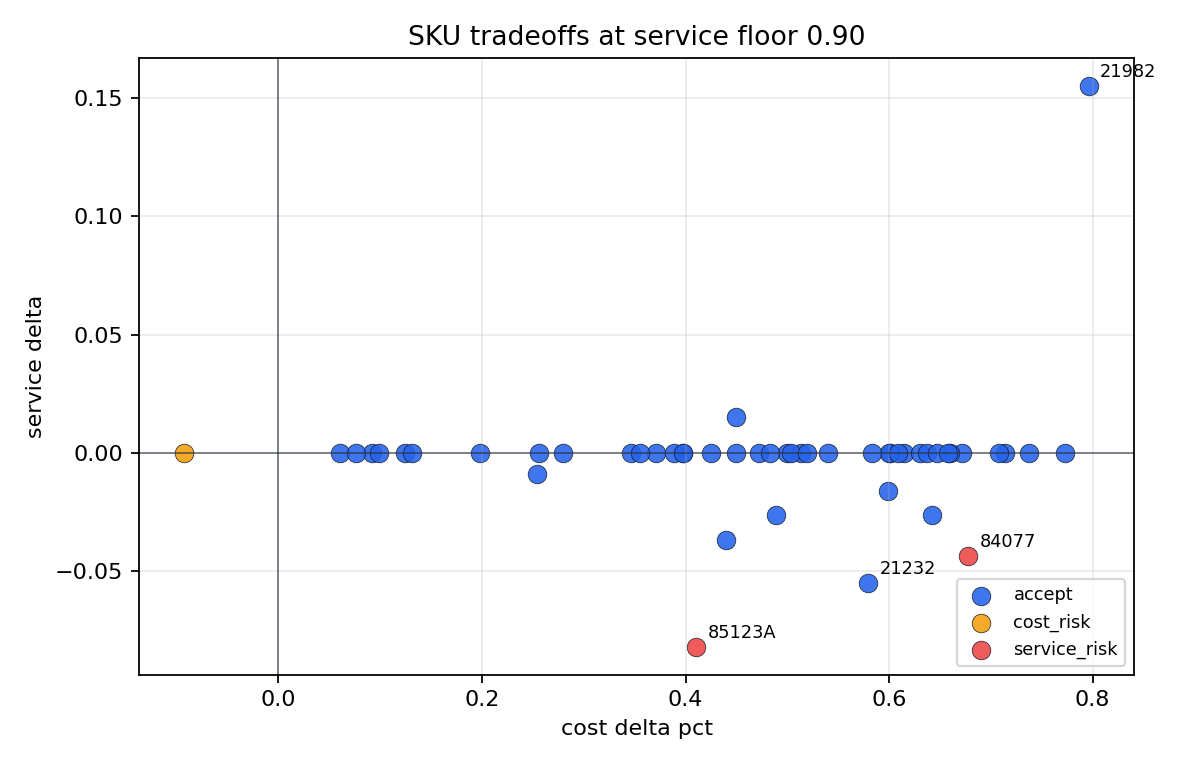
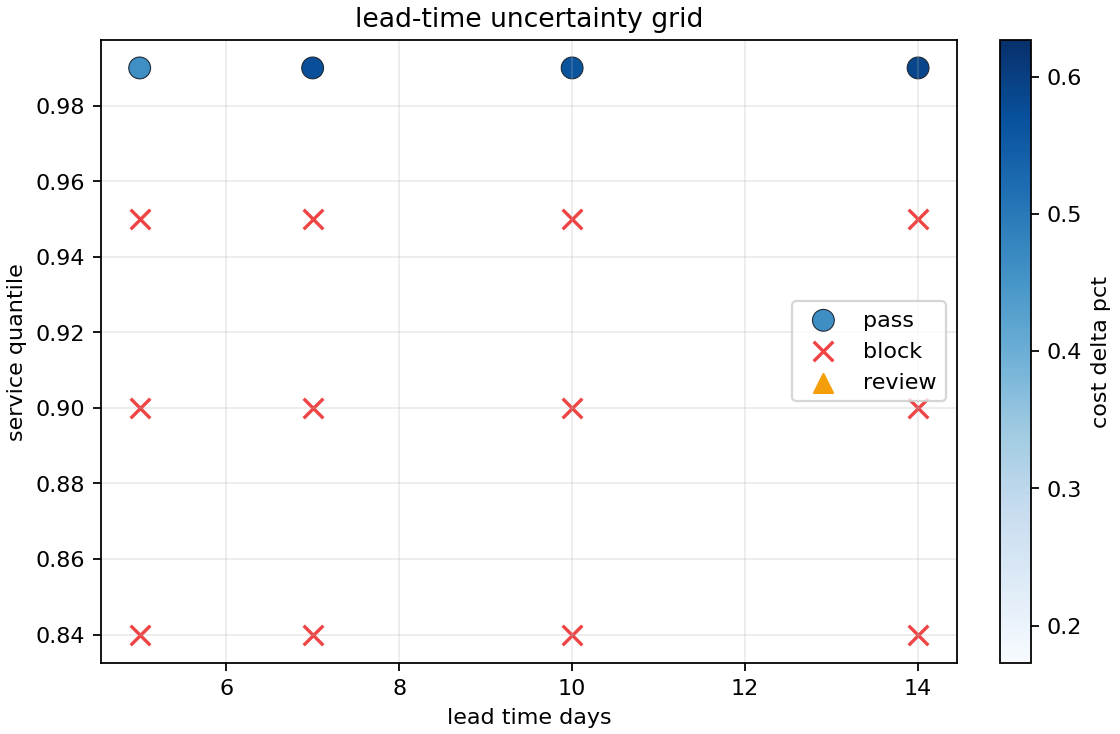
- top 50 SKUs, 3,000 test rows
- model WAPE: 0.865 vs baseline 1.070
- model policy cost: 158,345.68 vs baseline 372,195.68
- final gate: review; robust q 0.99 passes 4 / 4 lead-time settings
- lead-time blocks: 12 / 16; cost blocks: 27 / 36
- SKU floor: 48 / 50
- service-risk SKUs: 2
What the gate catches
- LOW_Q_STOCKOUT: 3 / 4 model frontier rows fall below the 0.90 service floor
- LEAD_TIME_FRAGILITY: 12 / 16 lead-time scenarios blocked; robust q 0.99 passes 4 / 4
- COST_WEIGHT_SENSITIVITY: 27 block, 0 review, 9 allow
- SKU_SERVICE_FLOOR_BREACH: 2 / 50 SKUs fall below floor even when aggregate gate passes
WAPE
Weighted forecast error; lower means closer to actual demand volume
service level
Share of demand served during the simulation window
sensitivity
How many cost-service scenarios still choose the model policy
lead-time pass
Lead-time scenarios where the model policy improves cost and stays above the service floor
Dataset simulation only; not production inventory advice